
Refer to Exhibit.
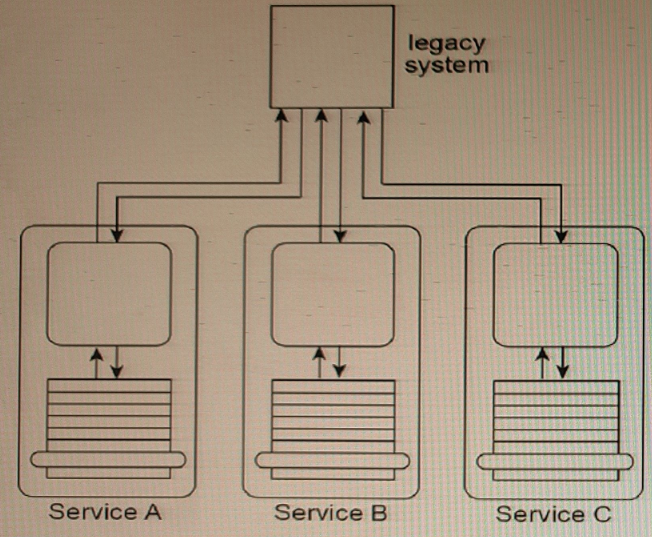
Service A, Service B, and Service C are entity services, each designed to access the same shared legacy system. Service A manages order entities, Service B manages invoice entities, and Service C manages customer entities. Service A, Service B, and Service C are REST services and are frequently reused by different service compositions. The legacy system uses a proprietary file format that Services A, B, and C need to convert to and from.
You are told that compositions involving Service A, Service B, and Service C are unnecessarily complicated due to the fact that order, invoice, and customer entitles are all related to each other. For example, an order has a customer, an invoice has an order, and so on. This results In calls to multiple services to reconstruct a complete order document. You are asked to architect a solution that will simplify the composition logic by minimizing the number of services required to support simple business functions like order management or bill payment. Additionally, you are asked to reduce the amount of redundant data transformation logic that is found in Services A, B, and C.
How will you accomplish these goals?
Refer to Exhibit.
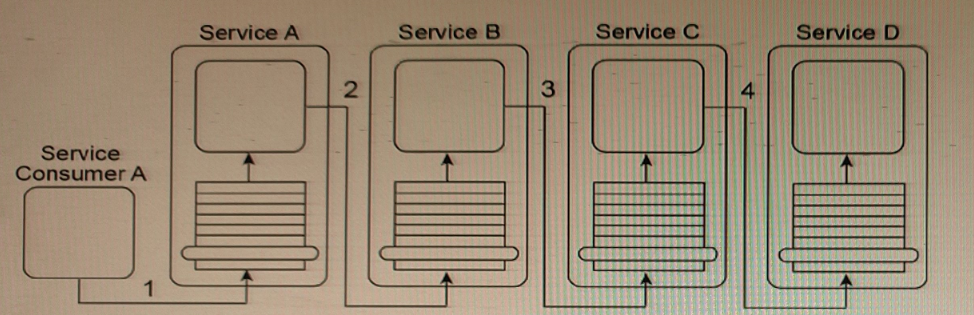
Service Consumer A sends a message to Service A (1), which then forwards the message to Service B (2). Service B forwards the message to Service C (3), which finally forwards the message to Service D (4). However, Services A, B and C each contain logic that reads the contents of the message to determine what intermediate processing to perform and which service to forward the message to. As a result, what is shown in the diagram is only one of several possible runtime scenarios.
Currently, this service composition architecture is performing adequately, despite the number of services that can be involved in the transmission of one message. However, you are told that new logic is being added to Service A that will require it to compose one other service to retrieve new data at runtime that Service A will need access to in order to determine where to forward the message to. The involvement of the additional service will make the service composition too large and slow.
What steps can be taken to improve the service composition architecture while still accommodating the new requirements and avoiding an increase in the amount of service composition members?
Refer to Exhibit.
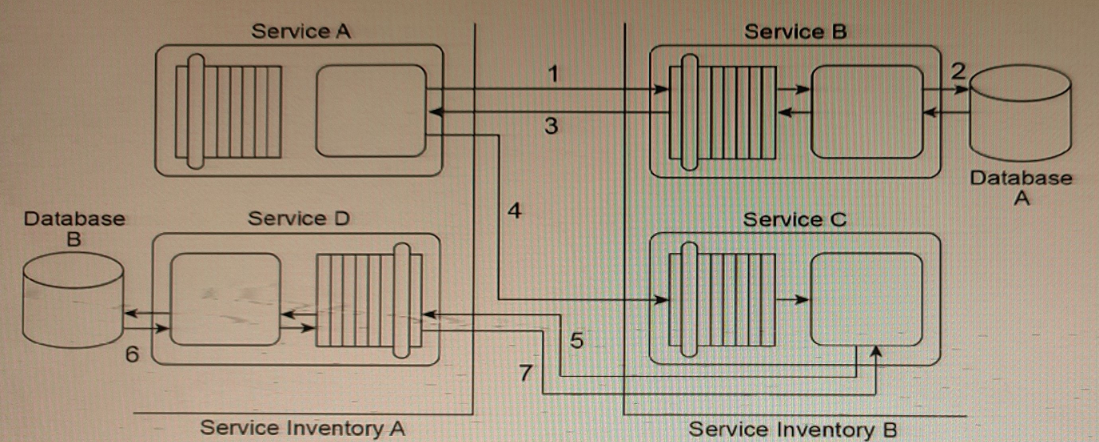
Service A sends a message to Service B (1). After Service B writes the message contents to Database A (2), it issues a response message back to Service A (3). Service A then sends a message to Service C (4). Upon receiving this message, Service C sends a message to Service D (5), which then writes the message contents to Database B (6) and issues a response message back to Service C (7).
Service A and Service D are located in Service Inventory
You are told that In this service composition architecture, all four services are exchanging invoice-related data in an XML format. However, the services in Service Inventory A are standardized to use a different XML schema for invoice data than the services in Service Inventory B. Also, Database A can only accept data in the Comma Separated Value (CSV) format and therefore cannot accept XML-formatted data. Database B only accepts XML-formatted data. However, it is a legacy database that uses a proprietary XML schema to represent invoice data that is different from the XML schema used by services in Service Inventory A or Service Inventory B.
What steps can be taken to enable the planned data exchange between these four services?
Refer to Exhibit.
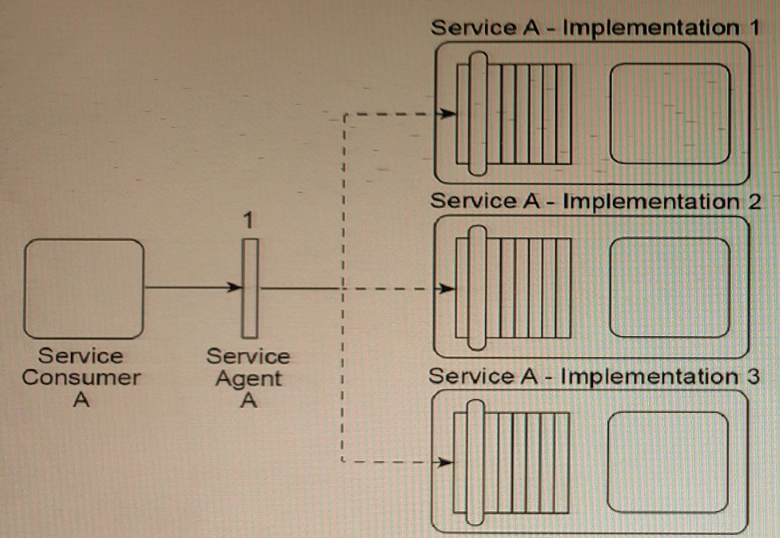
Service Consumer A sends a message to Service
You are told that despite the fact that duplicate implementations of Service A exist, performance is still poor at times. You are also informed that a new service capability will soon need to be added to Service A to introduce functionality that will require access to a shared database being used by many other clients and applications in the IT enterprise. This is expected to add further performance demands on Service A.
How can this service architecture be changed to improve performance in preparation for the addition of the new service capability?
Refer to Exhibit.

Service Consumer A and Service A reside in Service Inventory
You are an architect with a project team that is building services for Service Inventory A. You are told that the owners of Service Inventory A and Service Inventory B are not generally cooperative or communicative. Cross-inventory service composition is tolerated, but not directly supported. As a result, no SLAs for Service B and Service C are available and you have no knowledge about how available these services are. Based on the service contracts you can determine that the services in Service Inventory B use different data models and a different transport protocol than the services in Service Inventory A. Furthermore, recent testing results have shown that the performance of Service D is highly unpredictable due to the heavy amount of concurrent access it receives from service consumers from other organizations. You are also told that there is a concern over how long Service Consumer A will need to remain stateful while waiting for a response from Service A.
What steps can be taken to solve these problems?