Cisco 300-435 Exam Topics - You’ll Be Tested in Actual Exam
You will do better if you stop thinking in terms of commands and start thinking in terms of data models and workflows. This exam cares about whether you can read structured output, change it safely, and push it back using the right interface. The foundation piece matters because everything else assumes you understand how automation tools talk to networks, what JSON and YANG shaped data looks like, and why idempotent logic beats clever one off scripts. From there, a lot of the scoring comes down to APIs and protocols, where you need to recognize when REST is the right fit, how to handle authentication, pagination, and error codes, and how model driven interfaces differ from screen scraping. Device programmability shows up as the practical layer where you translate intent into calls against network operating systems and verify results through returned state, not just by hoping the config took. The controller domains raise the stakes because you are expected to work with centralized systems that expose inventory, topology, policy, and templates through APIs, then chain those calls into repeatable tasks. Candidates often trip on small details like confusing configuration with operational state, or treating API responses as text instead of structured objects. If you can practice building a simple flow that queries state, makes a change, and then validates the outcome across an enterprise controller and a WAN or cloud managed stack, you will feel the exam click into place.
Cisco 300-435 Exam Short Quiz
Attempt this Cisco 300-435 exam quiz to self-assess your preparation for the actual Cisco Automating and Programming Cisco Enterprise Solutions exam. CertBoosters also provides premium Cisco 300-435 exam questions to pass the Cisco Automating and Programming Cisco Enterprise Solutions exam in the shortest possible time. Be sure to try our free practice exam software for the Cisco 300-435 exam.
1of 0 questions |
Cisco 300-435 Exam Quiz
✓ 0 answered
🔖 0 bookmarked
Cisco300-435
Q1:
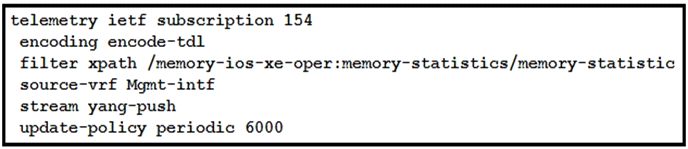
Refer to the exhibit.
The configuration commands are entered in CLI config mode to configure a static telemetry
subscription on a Cisco IOS XE device. The commands are accepted by the device, but the consumer receives
no telemetry dat
a. Which change must be made to ensure that the consumer receives the telemetry data?
○
AThe IP address of the receiver must be set.
○
BThe stream type must be set to YANG.
○
CThe update policy period must be shortened.
○
DThe sender IP address must be set.
Cisco300-435
Q2:
Refer to the exhibit. A Python script is used to configure a Cisco IOS XE router. The Loopback2 interface currently has a description of Management2 and an IP address/netmask of 10.222.34.22/32. What is the result of executing the script?
○
AThe interface description remains the same.
○
BThe router rejects all commands and the configuration remains the same.
○
CThe interface is removed from the configuration.
○
DThe interface description is removed from the configuration.
Cisco300-435
Q3:
Refer to the exhibit. Interfaces named Loopback0, Loopback1, and Loopback2 must be created and enabled on a Cisco IOS XE target device in the lab group. Which loop must be added to the end of the Ansible ''create int'' task?
○
Awith_items: ''{{intlist}}''
○
Bwith_parent: ''{{intlist}}''
○
Cwith_list: ''{{intlist}}''
○
Dwith_groups: ''{{intlist}}''
Cisco300-435
Q4:
What does Cisco DNA Center use to manage third-party devices?
○
Acommand runners
○
Bmultivendor SDK
○
Ctemplates
○
Ddevice packages
Cisco300-435
Q5:
When working with MV Sense APIs, which type of protocol is MQTT based upon?