Available Number of Questions: Maximum of
175 Questions
Exam Name: Implementing Secure Solutions with Virtual Private Networks
Exam Duration: 90 Minutes
Related Certification(s):
Cisco CCNP, Cisco CCNP Security Certifications
Cisco 300-730 Exam Topics - You’ll Be Tested in Actual Exam
You will spend less time memorizing terms and more time proving you can make VPN pieces agree when they do not want to. The exam leans hard on secure communications architecture choices because those choices decide everything that follows, from which traffic should be protected to how peers authenticate and what crypto settings are acceptable. From there, site to site VPNs on routers and firewalls are where you show you can build tunnels that actually pass the right subnets, handle interesting traffic selection, and survive real routing and policy interactions instead of a clean lab diagram. Remote access VPNs then tests whether you can think like both an admin and a user, dealing with client connectivity, address assignment, split tunneling decisions, and the practical effects of pushing policies down to endpoints. Troubleshooting is not a separate island, it is the thread that ties the other domains together, because you are expected to read what the device is telling you in ASDM and the CLI and turn that into the next best check. Candidates often get tripped up by chasing symptoms at the wrong layer, like tweaking crypto when the problem is NAT, ACLs, or identity mismatch, so practice forming a quick hypothesis and validating it with a small set of commands and logs before you change anything.
Cisco 300-730 Exam Short Quiz
Attempt this Cisco 300-730 exam quiz to self-assess your preparation for the actual Cisco Implementing Secure Solutions with Virtual Private Networks exam. CertBoosters also provides premium Cisco 300-730 exam questions to pass the Cisco Implementing Secure Solutions with Virtual Private Networks exam in the shortest possible time. Be sure to try our free practice exam software for the Cisco 300-730 exam.
1of 0 questions |
Cisco 300-730 Exam Quiz
✓ 0 answered
🔖 0 bookmarked
Cisco300-730
Q1:
An organization wants to implement a site-to-site VPN solution that must be able to support 350 sites with direct communications between all sites, fully encrypt the packet header and payload, and support propagation of routing information over IPsec. Which solution meets these requirements?
○
AIPsec full mesh
○
BDMVPN
○
CGETVPN
○
DFlexVPN
Cisco300-730
Q2:
An engineer is building an IKEv1 tunnel to a peer Cisco ASA, but the tunnel is failing. Based on the configuration in the exhibit, which action must be taken to allow the VPN tunnel to come up?
○
AAdd a route for the 10.7.7.0/24 network to egress the outside interface.
○
BEnable IKEv1 on the outside interface.
○
CChange the IKEv1 policy number to be at least 256.
○
DChange the transform set mode to transport.
Cisco300-730
Q3:
When troubleshooting FlexVPN spoke-to-spoke tunnels, what should be verified first?
○
ANHRP redirect is enabled on the hub.
○
BThe spokes have sent a resolution request.
○
CNHRP cache entries exist on the spoke.
○
DNHO routes exist on the spokes.
Cisco300-730
Q4:
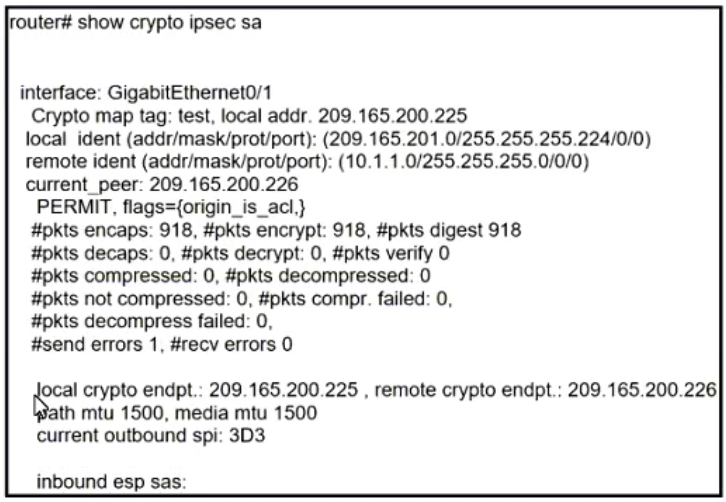
A TCP based application that should be accessible over the VPN tunnel is not working. Pings to the appropriate IP address are failing.
Based on the output, what is a fix for this issue?
○
AAdd a route on the remote peer for 209.165.201.0/27.
○
BAdd a route on the local peer for 10.1.1.0/24.
○
CAdd a permit for TCP traffic going to 10.1.1.0/24.
○
DAdd a permit for TCP traffic going to 209.165.201.0/27.
Cisco300-730
Q5:
The corporate network security policy requires that all internet and network traffic must be tunneled to the corporate office. Remote workers have been provided with printers to use locally at home while they are remotely connected to the corporate network. Which two steps must be executed to allow printing to the local printers? (Choose two.)
☐
AConfigure the split-tunnel-policy on the Cisco ASA to tunnelall.
☐
BCheck the Allow Local LAN access checkbox in the Cisco AnyConnect client.
☐
CAdd a persistent static route in the client OS for the local LAN network.
☐
DConfigure the split-tunnel-policy on the Cisco ASA to excludespecified.
☐
EConfigure the split-tunnel-policy on the Cisco ASA to tunnelspecified.