F5 Networks 301a Exam Topics - You’ll Be Tested in Actual Exam
The F5 Networks 301a exam is a comprehensive assessment designed to evaluate your understanding of various network-related concepts and technologies. It covers a wide range of topics, including network security, application delivery, and infrastructure management. You'll delve into the fundamentals of network protocols, such as TCP/IP, and explore their role in data transmission. The exam also emphasizes the importance of network optimization techniques to enhance performance and efficiency. Additionally, you'll learn about different types of network attacks and the measures to mitigate them, ensuring the security and integrity of network systems. Another key aspect is the management and configuration of network devices, including routers and switches, to create robust and scalable network architectures. The exam also introduces you to the world of virtualized networking, where you'll understand the benefits and challenges of software-defined networking (SDN) and network functions virtualization (NFV). Furthermore, you'll explore the latest trends in network automation and orchestration, which are crucial for efficient network management. Lastly, the exam covers network troubleshooting and diagnostics, equipping you with the skills to identify and resolve common network issues.
F5 Networks 301a Exam Short Quiz
Attempt this F5 Networks 301a exam quiz to self-assess your preparation for the actual F5 Networks BIG-IP LTM Specialist: Architect, Set up, Deploy exam. CertBoosters also provides premium F5 Networks 301a exam questions to pass the F5 Networks BIG-IP LTM Specialist: Architect, Set up, Deploy exam in the shortest possible time. Be sure to try our free practice exam software for the F5 Networks 301a exam.
1of 0 questions |
F5 Networks 301a Exam Quiz
✓ 0 answered
🔖 0 bookmarked
F5 Networks301a
Q1:
An LTM device an application that requires all connections to be secured via SSL The device must verify that request contain a specific cookie before allowing the request to be sent to the pool member.
Which virtual server type should an LTM Specialist configure on the LTM device?
○
AStateless
○
BPerformance (HTTP)
○
CStandard
○
DPerformance (Layer 4)
○
EForwarding (IP)
F5 Networks301a
Q2:
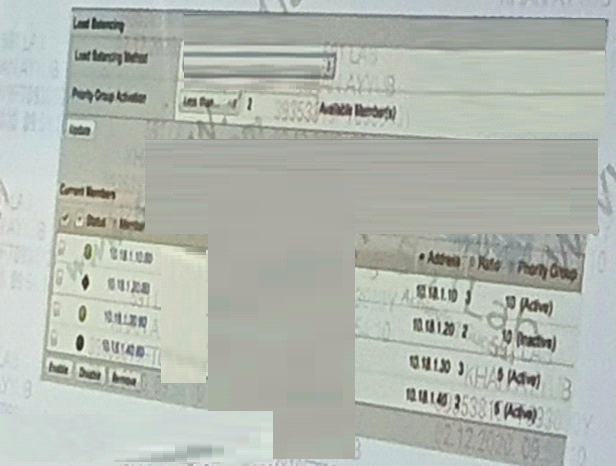
Refer to the exhibit.
The pool shown is configured with four pool members in a variety of states. The application is receiving a large number of request. The LTM Specialist needs to make changes to make sure that all members receive the same levels of traffic.
Which changes need to be made?
○
AEnable 10.80.1.40 disable priority group activation, enable ratio
○
BEnable 10.80.1.40 and 10.80.1.1.20 disable group activation, enable Round Robin
○
CEnable 10.80.1.20 disable priority group activation, enable Round Robin
○
DEnable 10.80.1.40 and 10.80.1.20 disable priority group activation, enable ratio.
F5 Networks301a
Q3:
The network team introduces a new subnet 10.10.22.0/24 to the network. The route needs to be configured on the F5 device to access this network via the 30.30.30.158 gateway.
How should the LTM Specialist configure this route?
○
ATmsh modify net route 10.10.22/24 gw 30.30.30.158
○
BTmsh create net route 10.10.22/24 gw 30.30.30.158
○
CTmsh changey net route 10.10.22/24 gw 30.30.30.158
○
DTmsh add net route 10.10.22/24 gw 30.30.30.158
F5 Networks301a
Q4:
An LTM Specialist needs to use the tmsh command to create a pool named http_pool with member
10.10.101:80 on an LTM device.
Which expression should the LTM Specialist use?
○
A# tmsh create pool http_pool members {10.10.10.101:80}
○
B# tmsh create pool http_pool members add {10.10.10.101:80}
○
C# tmsh create it pool http_pool members {10.10.10.101:80}
○
D# tmsh create itm pool http_pool member {10.10.10.101:80}
F5 Networks301a
Q5:
An LTM Specialist is configuring a client profile to offload processing a new application Company policy requires that clients can resume session for up to 30 minutes, but must renegotiate a new session after that.
Which setting should the LTM Specialist change to satisfy this requirement?