
Fortinet
NSE6_FML-7.2
Q1:
Refer to the exhibit which shows a topology diagram of a FortiMail cluster deployment.
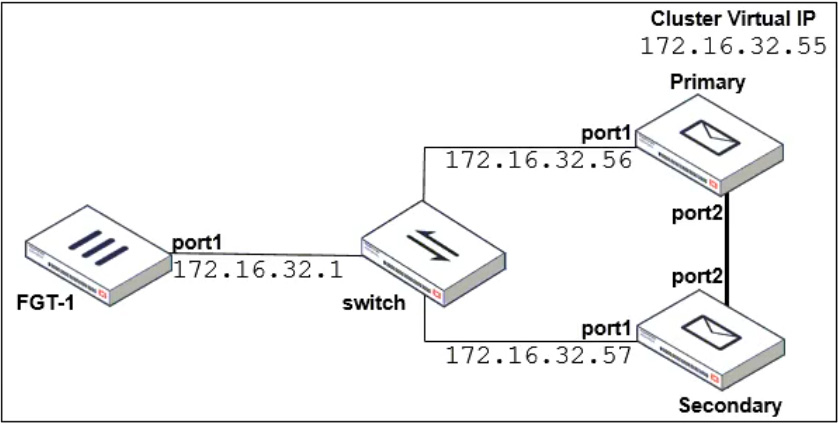
Which IP address must the DNS MX record for this organization resolve to?
○
A
1172 16 32 57○
B
172.16.32.56○
C
172.16.32.55○
D
172.16.32.1
Fortinet
NSE6_FML-7.2
Q2:
While reviewing logs, an administrator discovers that an incoming email was processed using policy IDs 0:4:9:INTERNAL.
Which two statements describe what this policy ID means? (Choose two.)
☐
A
Access control policy number 9 was used.☐
B
The FortiMail configuration is missing an access delivery rule.☐
C
The email was processed using IP-based policy ID 4.☐
D
FortiMail is applying the default behavior for relaying inbound email.
Fortinet
NSE6_FML-7.2
Q3:
Refer to the exhibit which shows an nslookup output of MX records of the example.com domain.
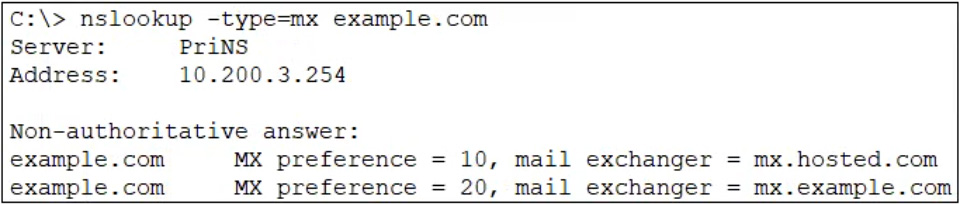
Which two MTA selection behaviors for the example.com domain are correct? (Choose two.)
☐
A
mx.example.com will receive approximately twice the number of email as mx.hosted.com because of its preference value.☐
B
The primary MTA for the example.com domain is mx.hosted.com.☐
C
The external MTAs will send email to mx.example.com only if mx.hosted.com is unreachable.☐
D
The PriNS server should receive all email for the example.com domain.
Fortinet
NSE6_FML-7.2
Q4:
Which statement about how impersonation analysis identifies spoofed email addresses is correct?
○
A
It uses behavior analysis to detect spoofed addresses.○
B
It uses DMARC validation to detect spoofed addresses.○
C
It maps the display name to the correct recipient email address○
D
It uses SPF validation to detect spoofed addresses.
Fortinet
NSE6_FML-7.2
Q5:
Which two FortiMail antispam techniques can you use to combat zero-day spam? (Choose two.)
☐
A
IP reputation☐
B
Spam outbreak protection☐
C
DNSBL☐
D
Behavior analysis